
CRISPI Is Pretty Good, But Time Has Shown It's Fundamentally Flawed
So why is it flawed?
The founding idea behind CRISPI was simple: how do we define what a good, "powerful" deck is? Well... cEDH decks are powerful, right? Right. So if you want your deck to be powerful, it needs to do what cEDH decks do, right? Wrong. If you're playing in a casual pod and someone slams down a [[Portal to Phyrexia]] on turn 4, that's powerful-and you don't need a cEDH deck design to do that.
That's not a hypothetical. Here's a real one. This Cruelclaw deck runs Portal to Phyrexia, edict effects, and a pile of one-sided attrition. It's an oppressive deck if even one of those effects land, especially early. CRISPI rates it 5.19. This stock precon rates 5.13. According to CRISPI, those two decks belong at the same table but IRL Cruelclaw would dominate that precon, and it wouldn't be close. CRISPI can't see it, because Cruelclaw doesn't do the things cEDH decks do. It doesn't need to. This is just but one of many "problem decks" that have popped up along the way. Keep this example in mind; we'll come back to it.
After these many months (and nearly a dozen rounds of tuning), it's become evident to me that more tuning cannot fix the foundational problem: CRISPI simply wasn't designed to capture the "physics" of Magic, not fully. That doesn't mean everything CRISPI does is useless. More on that later. But when I came to this realization over the last couple of tuning rounds, it got me thinking about what a real solution might look like.
No Matter What, It Has To Come From the "Physics" of Magic.
The challenge is not cooking up a new system. In my experience, that's the easy part. The challenge is building a system that reflects the fundamentals every Magic game runs on. This is where I made my mistake with CRISPI: I tried to shortcut the hard part by letting cEDH "solve it" for me. I thought, "cEDH decks are the most powerful decks in the format, so their designs must reflect the physics of Magic and what makes a good deck. Whatever makes them great must be what makes any deck powerful and well-built." I now know that was foolish... but it sounds good, doesn't it?
No shortcuts this time. To be clear, I'm not claiming that what I'm about to present is perfect or logically flawless. That would be naive. What I'm hoping is that, together with your insights, we can design a system that closes the gap.
The "Physics" and the Questions That Answer Them
Magic, and Commander especially, is not an additive game. It is an economic race governed by compounding returns and multiplayer dynamics. Three foundational axioms describe this:
- Cards are contextual: A card only matters for what it does to the resource ledger (mana, cards, life, turn cycles, etc.) and to the plan of that specific deck. A [[Demonic Tutor]] in a precon-level deck is not the same card it is in a high-powered deck.
- Zones and life are aliases: The graveyard and exile are dead zones until they're not. Life is an expendable buffer, not a win-likelihood meter. Given the right deck, anything is possible and everything is usable.
- The turn clock is a multiplier: Decks can win either by severely contracting their own clock (Turbo/Combo) or by dilating the table's clock (Stax/Attrition).
But what does knowing this do for us? It lets us ask questions that are rooted in the physics. And because those questions are fundamental to the game itself, we can use them to measure any deck universally.
12 Universal Benchmarks
So how do these axioms translate to Commander deck design? If you had to figure out what every deck ever built (or possible based on the current rules) has in common, I think it comes down to these five domains:
| Domain | What it measures |
|---|---|
| Resources | How well the deck can afford its plays and sustain the supply of cards and effects it needs |
| Access | How well it finds the specific pieces, or interchangeable effects, its plan needs |
| Pressure | When it presents threats, and how it does so |
| Interaction | Which opposing plans it can interrupt, when, and at what cost to its own development |
| Resilience | How well it can play through its important resources or plans being disrupted |
Then we get to the most interesting part. How do we answer these domain questions and the things they measure? With more questions, of course! Twelve is where I landed, and in testing, they seemed to cover everything. I'm not claiming 12 is the magic number. There could be more needed, but this was the smallest package I got to without losing anything. I just think these are a good start.
Domain 1: Resources (The Engine's Fuel)
- R1 (Mana Velocity & Sufficiency): How well does this deck produce the volume, colors, and tempo of mana (or cost-reduction/cheat effects) required to execute its game plan on its intended curve?
- R2 (Card Flow & Replenishment): How well does this deck generate net card advantage to fuel its plan beyond the standard draw step?
Domain 2: Access (Finding & Structuring the Plan)
- A1 (Selection & Functional Redundancy): How effectively does the deck eliminate variance to access specific pieces or interchangeable effects?
- A2 (Assembly Velocity): How reliably and quickly does the primary win plan or dominant engine become fully assembled and castable?
Domain 3: Pressure (Winning the Game)
- P1 (Critical Onset & Lethality): How quickly and consistently does this deck present a must-answer state (win attempt, hard lock, or parity-breaking board state)?
- P2 (Win Inevitability & Compactness): Once initiated, how many opponent untap cycles occur before this deck achieves an inevitable kill or total lockout?
- P3 (Exposure & Inevitability): How narrow is the interaction window capable of stopping this deck's win, and how easily can the table see it coming?
Domain 4: Interaction (Disrupting Opponents)
- I1 (Reactive Disruption): How efficiently and flexibly can the deck disrupt opposing spells, permanents, or attacks at instant speed?
- I2 (Proactive Restriction & Denial): How effectively does the deck lock out, tax, or systematically strip opponents of resources while breaking parity?
Domain 5: Resilience (Surviving to Win)
- S1 (Plan Shielding & Protection): How reliably can the deck protect its critical spells, permanents, or win turns from disruption?
- S2 (Engine Recovery): How well does this deck rebuild its board, mana, or engine after a major wipe or disruption?
- S3 (Independence & Backup Plans): How well can the deck function and win if its commander or primary centerpiece is neutralized?
Look back at the three axioms and you'll see them baked into these questions. Not one of them asks "how many tutors" or "how many counterspells." They ask how well the deck does a thing for its plan, because cards are contextual. That's axiom one, and it's the reason every answer comes with a Card Ledger (more on that below). Recursion from the graveyard counts toward R2 and A1 the same way a draw spell does, and exile is just another zone your plan might live in. That's axiom two. And axiom three, the turn clock, is the whole reason these twelve questions are not weighted equally, which is where we go next.
Because these domains and questions are not equal. Magic is not equal in this sense. It doesn't matter how well your deck recovers from a board wipe if you win every game before anyone has the mana to cast one. What's the point of packing in a suite of recursion if the turn clock is all that matters to you?
Benchmark Weighting: Clock vs. Insurance
In an initiative-driven game, active threats and passive hedges do not carry equal utility. A deck that threatens a protected, game-ending thing on turn 2 rarely cares about engine recovery. It's an all-or-nothing strategy.
To model real game physics, the benchmarks are split into three scoring tiers:
- Terminal Clock Vectors (R1, A2, P1, P2 -- max 10 pts each): These govern the turn clock. Presenting a must-answer state early forces all three opponents into a reactive, defensive posture. These four are the format's necessary and sufficient win conditions.
- Execution Modifiers (R2, A1, P3, S1, I1, I2 -- max 8 pts each): These govern throughput, protection, and table pacing. They determine whether an initiated attempt actually resolves through multiplayer resistance (in other words, how good is your win con, really?).
- Contingency Buffers (S2, S3 -- max 4 pts each): Engine recovery and commander independence are hedges that only pay off after your primary game plan has collapsed. Discounting them stops non-functional or fragmented decks from scoring unearned points simply because their commander was irrelevant to begin with.
How a benchmark gets answered
Each of the 12 questions is answered with a quality tier, S through F, on this scale:
- S (Decisive / Format Ceiling): Flawlessly satisfies the plan. Creates an unrecoverable resource disparity, a game-ending lock, or executes at format-ceiling efficiency.
- A (Compounding Advantage): Generates recurring surplus, multi-card swings per turn cycle, or scaling engines that outpace the table.
- B (Advantage / High Synergy): Net positive on curve. Reliably meets the deck's demands without compounding.
- C (Parity / Functional Baseline): Even trades, variance smoothing, or minimum baseline operation. No surplus.
- F (Deficit / Impaired): Net loss. Costs more than it returns, fails to support the curve, or is dead/uncastable.
Every benchmark also has its own ladder that spells out what each tier means for that question. For P2, for example, S means the win needs 0 opponent untap steps (instant-speed win, storm out, same-turn combo), A means 1, B means 2, C means 3, and F means 4+ or indefinite chip damage. For R1, S means 0–1 CMC positive-mana rocks and rituals with flawless fixing, B means solid on-curve 2–3 CMC ramp, and C means tap-land friction.
The tier letter then converts to points based on which weighting group the benchmark sits in:
| Group | S | A | B | C | F |
|---|---|---|---|---|---|
| Terminal Clock (R1, A2, P1, P2) | 10 | 5 | 2 | 1 | 0 |
| Execution Modifiers (R2, A1, P3, S1, I1, I2) | 8 | 4 | 2 | 1 | 0 |
| Contingency Buffers (S2, S3) | 4 | 2 | 1 | 0 | 0 |
Two things to notice. First, the points roughly halve with each step down. An S is not "one better" than an A; it's worth double, because format-ceiling performance on a benchmark is rare and it warps the whole game. Second, the group matters as much as the letter. An S in P1 (a lethal threat on turns 1–3) is worth 10 points. An S in S3 (your deck wins fine without its commander) is worth 4. An A in R1 (5 points) outscores an S in S2 (4 points), because playing two turns ahead on mana does more to win games than rebuilding well after you've already been wiped.
The 12 point values add up to a Threat Score out of a maximum of 96 (being S-tier across everything).
One thing I want to be clear about, because it matters for everything that follows: the AI's only job is to answer the twelve questions. It reads the deck and hands back twelve letters, each with a reason. Everything after that is handled by code. The points, the Threat score, the bracket floors, and the gatekeepers below are all deterministic. Same twelve letters in, same result out, every time.
And that's the framework! For now, I'm calling it the DeckCheck Threat Index (DTI).
Next up: how it works with bracket placement, and then how it connects back to CRISPI.
Solving the Middle Compression
Bracket 3 is the widest and most volatile tier in Commander. Right now it holds everything from honest, upgraded precons to oppressive, asymmetric midrange engines. To fix this, the new framework pairs calibrated score floors with hard mechanical gatekeepers (just like the current CRISPI system does):
| Bracket | DTI Floor | Turn Target | Defining Characteristic |
|---|---|---|---|
| Bracket 5 (cEDH) | 68+ | Turns 1–3 | Format ceiling; compact, stack-only wins |
| Bracket 4 (Optimized) | 42 – 67 | Turns 4–5 | High-velocity engines; severe attrition |
| Bracket 3 (Upgraded Casual) | 30 – 41 | Turns 6–7 | Synergy-driven; multi-turn combat clocks |
| Bracket 2 (Core / Precon) | 16 – 29 | Turns 8+ | Stock precons; tap-land friction; fair curves |
| Bracket 1 (Exhibition) | Under 16 | Turns 10+ | Fragile gimmicks; extreme mechanical friction |
The bracket you see starts from the official WotC bracket guidelines. Game Changers, mass land denial, extra turns, all of it. My system sits on top of that and can only push a deck up, never down. If the official guidelines already put your deck in Bracket 4, you're in Bracket 4. If the guidelines say Bracket 3 but your Threat score or one of the gatekeepers says otherwise, you get promoted. The point of this system is to catch the decks the card lists miss, not to argue with the card lists.
The Gatekeepers
A high-pressure deck should never slip into a lower bracket just because it lacks raw card draw or counterspells or tutors. So on top of the score floors, four hard rules promote a deck regardless of its aggregate score. Two of them use what I call the threat vectors: the Velocity vector adds up R1, A2, P1, P2, and S1 (how fast and how protected is your own clock), and the Suppression vector adds up R1, I2, I1, P1, and S3 (how hard do you stop everyone else's).
- The cEDH Gate (to Bracket 5): If a deck's peak threat vector is 40 or higher, it presents a lethal threat on turns 1–3 (
P1in tier S/A), and it wins with 0 opponent untap steps (P2: S), it is a cEDH deck even if its total Threat score is under 68. This catches the turn-2 glass cannons that skimp on card flow and recovery because they don't plan to need them.
- The Velocity Gate (to Bracket 4): A Velocity vector of 28 or higher promotes a deck to Bracket 4 on its own. A clock that fast doesn't belong at a casual table, whatever the rest of the deck looks like.
- The Zero-Untap Override (to Bracket 4): If a deck threatens an assembled win on turns 1–5 (
P1orA2in S/A) and needs 0 opponent untap steps (P2: S) to end the game, it is promoted to Bracket 4. Casual Bracket 3 pods do not run the density of free countermagic required to interact with same-turn spell-chain kills.
- The Oppression Quarantine (to Bracket 4): Any deck that deploys severe asymmetric locks or recurring attrition (
I2in S/A) during the early game (P1orA2in S/A) is quarantined to Bracket 4. Even if the deck wins through fair combat damage, establishing a one-sided resource choke with cards like Grave Pact, Portal to Phyrexia, or heavy edict loops strips opponents of basic game actions and creates non-games. That belongs in Optimized pods, not casual games.
Back to Cruelclaw
Remember the Cruelclaw deck that CRISPI rated a hair above a precon? Here's how it comes out under the new system. It gets an A on R1, A2, and P1: it ramps, it assembles, and it presents a must-answer board on turns 4–5. It gets an S on I2, because Portal to Phyrexia and the edict package are exactly the kind of one-sided resource choke I2 measures. Everything else lands at A or B. Add it up and you get a Threat score of 42, which puts it in Bracket 4 on the score floor alone. And even if it had come in at 38, the Oppression Quarantine (I2 S with P1 A) would have promoted it anyway. That's the whole point of the gatekeepers: an oppressive deck can't hide in Bracket 3 by being merely fine at everything else.
The Card Ledger: Every Card, Every Benchmark
Now for the part I alluded to earlier: how this connects to CRISPI. Probably the best thing about CRISPI is how much easier it makes iterating on your deck. Seeing exactly which cards drive which stats is genuinely useful. I don't want to lose that. More than that, a score you cannot inspect is just an opinion. So every benchmark rating ships with a Card Ledger: an exhaustive map of which cards in your 99 support that benchmark.
This is not a "key cards" highlight reel. Command Tower, your fetchlands, and your triomes all appear under R1, because they are the fixing that R1 measures. Esper Sentinel appears under R2 for the card flow, under I2 for the tax, and under A2 if it feeds a creature threshold. One card can carry several benchmarks, so a typical list will have the same card in many places.
The implementation is the important part. In this new paradigm, likely it will look something like this: you'd click a benchmark to see exactly which cards earned its tier. You'd hover a card in the builder to see which benchmarks it serves. If your R2 came back as a C, you'd see the four cards that were the only entries, and you'd know exactly what to target in your next tuning pass.
So what happens to CRISPI?
If this goes ahead, CRISPI goes away. Not "gets tuned again." Goes away. The six CRISPI attributes would be replaced by these twelve benchmarks, and the twelve tiers would effectively become the new attribute ratings you see on a deck. CRISPI would be replaced by the DeckCheck Threat Index (DTI) and the bracket logic above. The Card Ledger keeps the one thing CRISPI did really well, and would tie in with PowerTune and the rest.
Two caveats. First, every term in this post is up for debate. "Terminal Clock Vectors," "Oppression Quarantine," the benchmark names, all of it. I picked words that made sense to me while I was building it, not words that have been tested for clarity with anyone else. If something reads as confusing or overwrought, say so.
Second, there is no timeline on this. I'm not announcing a launch. I'm putting the logic in front of you because I'd rather find the fundamental flaw in my reasoning now, in a blog post, than after it's live on every deck on the site. Poke holes in it.
Tradeoffs
"There are no solutions, only trade-offs." -- Thomas Sowell
Here's the big catch with all of this: the twelve answers come from AI. The reason is simple. To know how useful [[Rishkar's Expertise]] is in a given deck, and to sort it correctly by its relevance to that deck, answering that strictly with code means building a full Magic rules and simulation engine. That's a mountain of work (setting aside the legal concerns of doing so for a site like mine), and it's something I'm just not going to do. But more importantly. I don't even need to. AI can see the entire deck in context and make an accurate quality assessment of [[Rishkar's Expertise]] for that specific deck. Is it perfect? No. Is it really good already and only get better with time? Yes.
I tested the whole concept of this framework against two questions:
- Can it correctly sort decks by power level and place them in the right bracket?
- Can it produce an accurate ledger?
And the results were an astounding YES!
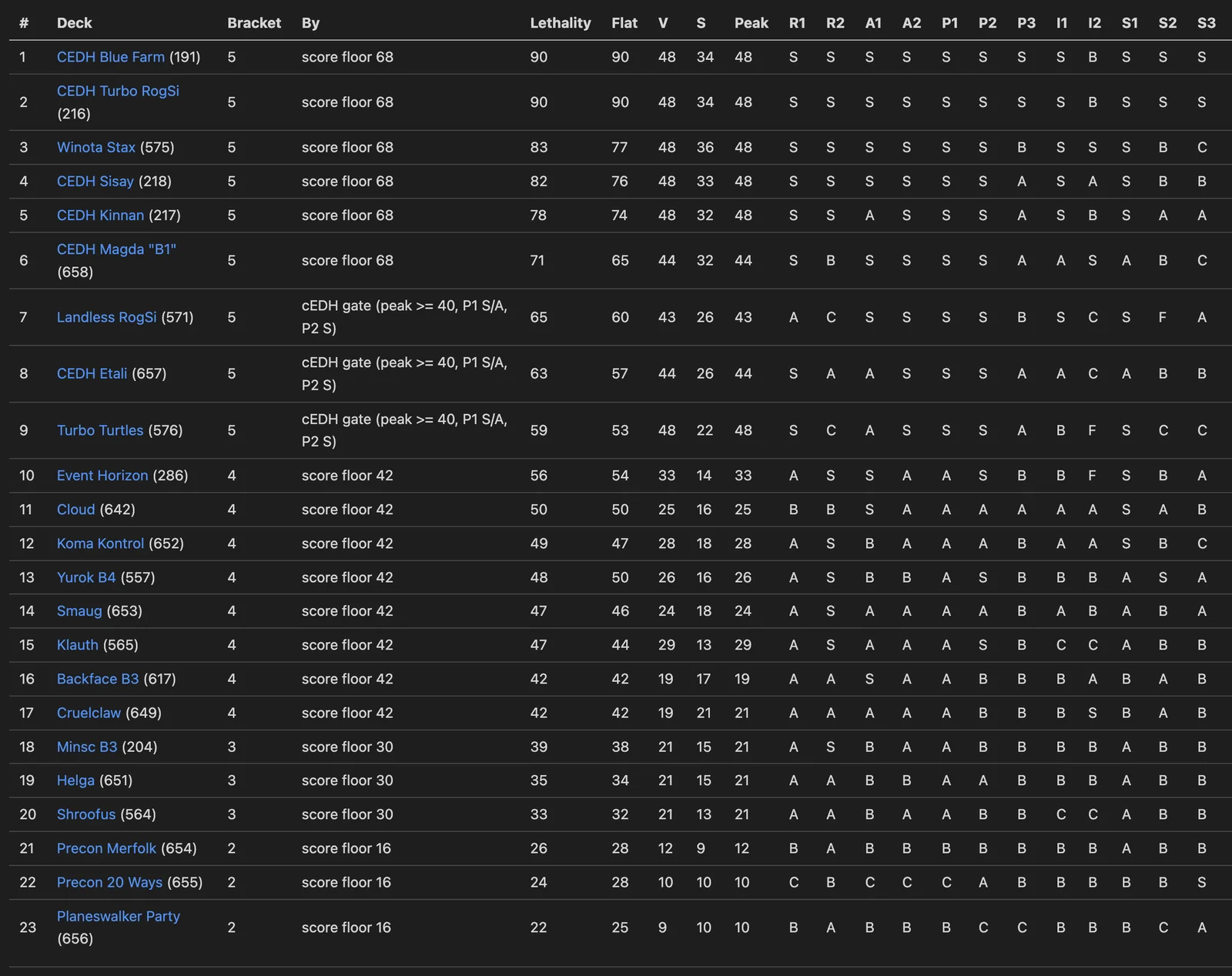
This is a spread of 23 different decks, sorted by DTI (I called it Lethality at the time of testing). A few things to look at:
- The top is right. Blue Farm and Turbo RogSi, two of the most established cEDH lists in the format, sit at the top with 90 out of 96 and S on nearly every benchmark. Winota Stax, Sisay, Kinnan, and "technically Bracket 1" Magda fill out the rest of Bracket 5 on the score floor.
- The gate works. Landless RogSi scored 65, under the Bracket 5 floor of 68, because a landless glass cannon has an F in Engine Recovery and a C in Card Flow. The cEDH Gate promoted it anyway, because a peak threat vector of 43 with a turn-1 win that needs zero untap steps is a cEDH deck, full stop. Same story for Etali and Turbo Turtles.
- The bottom is right. The three stock precons (Merfolk, 20 Ways, Planeswalker Party) land at 22 to 26, clustered together in Bracket 2, with B and C across the board.
- And look at Cruelclaw. Row 17. DTI 42, Bracket 4, an S in I2. The deck CRISPI put next to a precon now sits three brackets above one. That's the Portal to Phyrexia problem from the top of this post, solved.
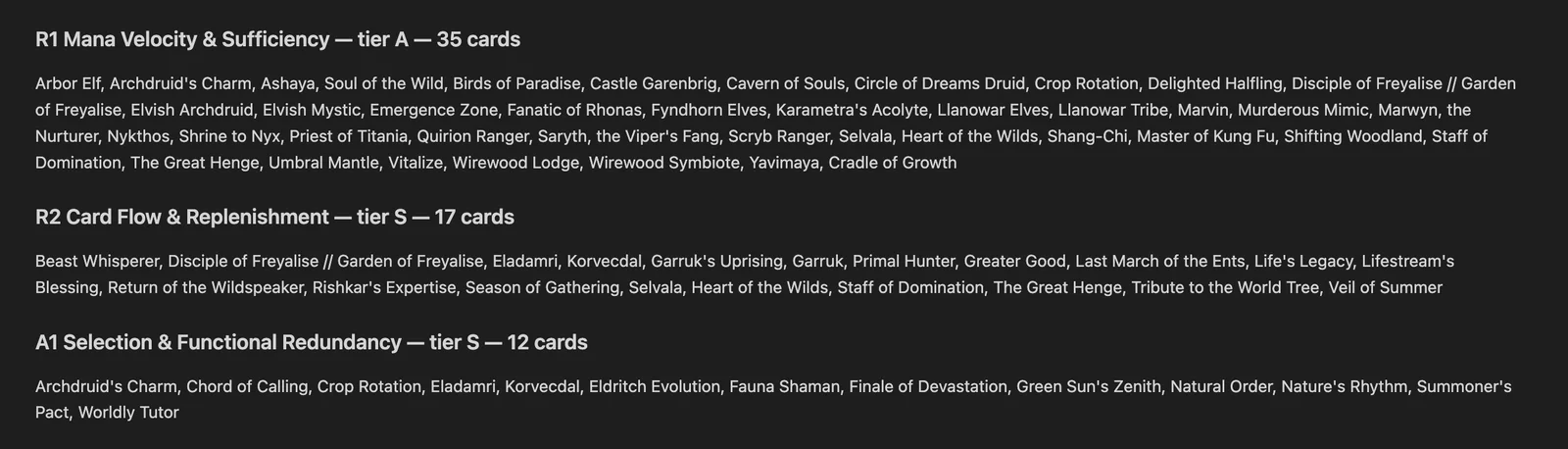
This is the ledger for Event Horizon (my baby deck), the mono-green turbocharged deck at row 10. R1 came back as an A with 35 cards behind it: every dork, every untapper, Cradle, Nykthos, The Great Henge. R2 came back as an S with 17 cards, and there in the list is Rishkar's Expertise, sitting next to Beast Whisperer, Garruk's Uprising, and The Great Henge again. That's the card I said needs context to judge, judged in context. A1 is an S-tier with the twelve tutors.
And while it is the case that the exact numbers can ebb and flow due to AI handling this (more on that in a sec), what matters is that they all move relative to one another.
So yeah, if re-run this exact test again and again (and I did), it does exactly what you'd expect from AI. The numbers ebb and flow. They drift up or down a couple of points, and there are two reasons for that: the reality of AI as a technology, and the reality of Magic. One of these sucks and is "bad" and I will do everything I can to reduce it if this goes live, and the other is just the nature of the game.
As you hopefully know by now, Magic is not a simple game to solve. Running one more draw spell doesn't automatically mean your deck's card flow is now far better than it was and deserves the next tier up. The benchmark questions (and the tiers used to answer them) are open-ended for exactly that reason, because Magic is open-ended. Ask ten different people "how good is this card in my deck?" and you'll get ten different answers, and they're probably all similar and all right in their own way. Likewise, many decks genuinely sit on the borderline between brackets, between tiers, and so why shouldn't the numbers reflect that? I personally think it's okay for things to ebb and flow, to reflect the nature of the game itself, so long as they don't ebb and flow wildly. What I mean is: a deck that scores an S on one run should not score a C on the next. That part comes down to the tech, and that's what needs to be weeded out. Your deck flipping between S and A does not, because it likely truly sits on that border.
The Most Important Thing
Now the most important part of all of it: what do you think? DeckCheck is where it is today because I take the power and the insight of this community seriously. Yall are not stupid. I don't know everything.
Any and all critique is welcome. But if you want somewhere to start, these are the three questions I most need answered:
- Are these the right twelve questions? Is there something about a deck's power that none of them capture? Is one of them redundant?
- Are the weights right? Should the four Clock benchmarks really be worth two and a half times a Resilience benchmark? Is halving S2 and S3 fair to decks built to grind?
- Are the terms confusing? Does DTI make sense? Should it just be called Power? Are there any other terms that are confusing?
If you think I'm wrong about the axioms themselves, I want to hear that most of all.
If you've made it to the end without skipping anything, you're amazing.
Cheers!
Keep reading
The DeckCheck Threat Index (DTI)
Today, CRISPI officially retires. Its replacement is the DeckCheck Threat Index (DTI), a new framework for evaluating Commander decks and helping you find the right bracket.

On Commander Power Levels
A deep dive on Commander power levels and the philosophy behind DeckCheck's power ratings.

Quality Maxxing
Starting December 1, Eco is going away, every tool runs at the best quality I can offer, credits get simpler, and every plan gets the same or more.
Comments
…